

Aviation
Aviation is reshaping the foundation of global connectivity and mobility, driving efficiency, strengthening operational resilience, and enabling the transition toward more advanced, sustainable, and future-ready air transport systems.
Aviation
Aviation has become the strategic frontier for global connectivity, operational resilience, and the evolving dynamics of air mobility, technological advancement, and sustainability transformation.
ThinXcope provides structured, independent insight across fleet modernization, passenger and cargo demand trends, airport and airspace infrastructure, emerging aviation technologies, and the shifting global aviation landscape.
Together, we help you navigate the most critical industry challenges; optimizing operational efficiency, managing cost and capacity, enhancing safety and resilience, and capturing strategic advantage in an increasingly dynamic and competitive aviation environment.
Aviation is redefining air mobility, operational efficiency, and the pace of innovation in an increasingly dynamic global environment.
Explore ThinXcope’s insights to anticipate demand shifts, technological advancements, and sustainability trends to capture strategic advantage in an increasingly complex and evolving aviation landscape.
Aviation Industry Outlook 2026: Growth
Under Constraint in a Structurally Transformed Sky
Executive Summary
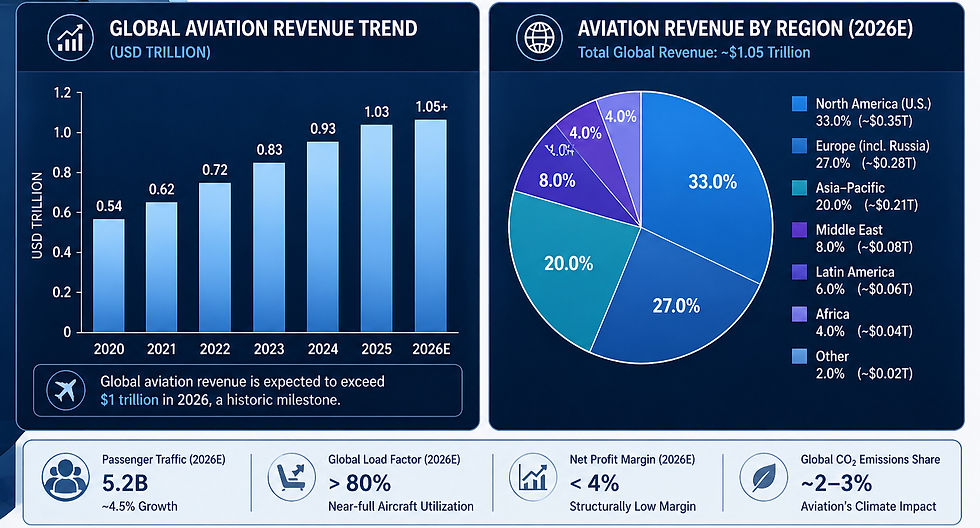
The aviation industry in 2026 enters a paradox: demand is strong, but growth is increasingly constrained. Passenger traffic is expected to reach ~5.2 billion with ~4.5% growth, and revenues will surpass $1 trillion. However, profitability remains structurally weak, with margins below 4%.
This signals a fundamental shift. Aviation is no longer recovering; it is restructuring into a capacity constrained, cost pressured, and increasingly complex global system.

1. Demand Strength Meets Physical Limits
Air travel demand continues to grow steadily, driven by international recovery and high load factors exceeding 80%. However, the industry is now supply constrained. Aircraft shortages, labor gaps, and infrastructure limitations are restricting the ability to scale capacity.
The key shift: growth is no longer demand driven. It is limited by physical and operational constraints.

2. Structural Capacity Constraints
Persistent supply chain disruptions, aircraft delivery delays, and reliance on aging fleets are creating a long term bottleneck. Airlines are extending aircraft life cycles, increasing maintenance and fuel costs.
These constraints are structural, not cyclical, reshaping pricing power and competitive dynamics across the industry.
3. Profitability: High Revenue, Low Margin Reality
Despite record revenues exceeding $1 trillion, aviation remains a low margin industry. Rising fuel costs, labor shortages, and maintenance expenses continue to pressure profitability.
The industry is profitable in absolute terms but remains economically fragile and highly sensitive to external shocks.
4. Geopolitics and Energy: A Volatile Operating Environment
Geopolitical tensions and energy price volatility are increasingly shaping aviation performance. Route disruptions, regulatory fragmentation, and supply chain instability are becoming key operational risks.
Aviation is evolving into a geopolitical system, deeply influenced by global stability and policy divergence.
5. Sustainability and Digital Transformation
Sustainability is a defining long term constraint, with aviation contributing ~2–3% of global emissions and facing challenges in scaling sustainable aviation fuel (SAF). At the same time, digital transformation and AI are improving efficiency, pricing, and operations.
The industry is transitioning into a data driven ecosystem where technology and sustainability will define competitiveness.
Conclusion
Aviation in 2026 is defined by strong demand but constrained growth. Structural bottlenecks, cost pressures, and geopolitical risks are reshaping the industry’s trajectory.
The next phase will require disciplined execution, operational efficiency, and strategic adaptation.
Final Takeaway:
The future of aviation is not about flying more. It is about flying smarter, cleaner, and more efficiently in a constrained world.
Aviation Industry Outlook 2026: Growth
Under Constraint in a Structurally Transformed Sky
Explore Further

Providers are redefining patient care delivery, enabling clinical excellence, digital health integration, and the evolving future of connected and value driven healthcare systems...Read More

Engineering and construction are redefining modern infrastructure, enabling smart development, resilient design, and the future of sustainable built environments...Read More

Manufacturing is redefining industrial production, enabling smart automation, supply chain resilience, and the future of connected manufacturing ecosystems...Read More