

Mobility
Mobility defines the future of movement, value creation, and connected transportation ecosystems.
Mobility
Mobility has become the strategic frontier for movement, value creation, connected ecosystems, and rapidly evolving transportation behaviors.
ThinXcope provides structured, independent insight across demand dynamics, pricing pressures, digital mobility platforms, supply chain transformation, and the evolving transportation landscape.
Together, we help you navigate the most critical industry challenges; optimizing operations, managing cost and complexity, enhancing user experience, and capturing strategic advantage in an increasingly intelligent and competitive mobility environment.
Mobility Industry Outlook 2026: Navigating the Transition to Electrified, Software-Defined Mobility
Mobility Industry Outlook 2026: Navigating
the Transition to Electrified, Software-Defined Mobility
Executive Summary
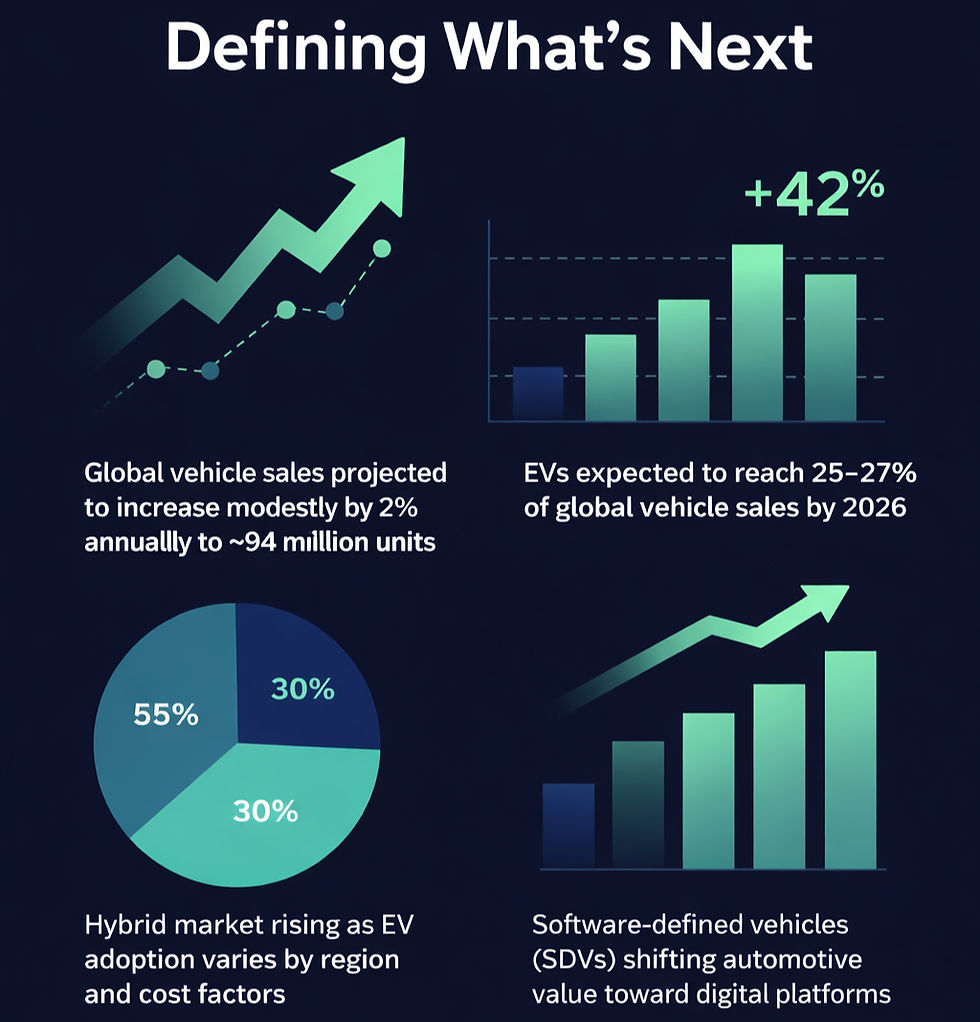
The mobility industry in 2026 stands at a critical inflection point, marked by modest growth and deep structural transformation. Global vehicle sales are expected to remain stable but constrained, while electrification, digitalization, and shifting consumer behavior reshape industry dynamics.
This is not a recovery phase; it is a strategic reset where success depends on balancing innovation, cost discipline, and adaptability in an increasingly complex and fragmented global market.
1. Constrained Growth & Market Shift
Global mobility growth is steady but slowing, driven by macroeconomic pressures, high interest rates, and affordability challenges.
Emerging markets are fueling incremental growth, while mature markets face stagnation. The industry is transitioning from volume-driven expansion to regionally differentiated and structurally constrained growth.


2. Electrification: Inevitable but Uneven
Electrification continues to define the industry, with EV adoption rising but at an uneven pace across regions.
Policy support, infrastructure readiness, and cost factors are creating divergence, while hybrid technologies are emerging as a practical transitional solution in many markets.
3. Software-Defined & Value-Driven Transformation
Vehicles are evolving into digital platforms, with software, connectivity, and data becoming core value drivers.
At the same time, consumers are becoming more price-sensitive and value-driven, forcing companies to rethink pricing, product mix, and revenue models.
4. Supply Chain, Costs & Competitive Pressure
Supply chains are shifting from global efficiency to regional resilience due to geopolitical tensions and trade disruptions.
Rising costs, high capital investments, and intensifying competition, especially from new entrants are driving margin pressure and forcing greater financial discipline across the industry.
Conclusion: The Age of Intelligent Retail
2026 will mark a clear divide between adaptive leaders and legacy operators. Success will depend on the ability to integrate electrification, software, and operational efficiency while navigating an increasingly fragmented and competitive global landscape.
Final Takeaway:
The future of mobility extends beyond vehicles. It lies in building connected, intelligent, and sustainable ecosystems that redefine how people and goods move.
Explore Further

E-commerce is reshaping retail and consumer behavior, enabling seamless digital transactions, global reach, and data-driven customer experiences...Read More

Retail is redefining consumer engagement, blending physical and digital channels to deliver personalized, seamless shopping experiences...Read More
